Tuesday, 14 March 2017

In the presence of giants

The next morning we rose with the sun...or was that son...either way we awoke to the view of the mountains, a canvas of light and shadow in the morning light. Despite being winter in New Zealand, the air was crisp and slightly warm in the suns rays. Mary-Ellen enjoyed her coffee on the deck in the early glow of morn; Thomas enjoyed his silly father taking pictures of him.


After watching the website to make sure the tours were running that morning, I was dropped off for the first tour while Mary-Ellen took first watch of the little bundle of joy and a little tourist shopping on the main strip of Kaikoura. With the weather feeling like an Autumn day in Maritime Canada, the setting perfect with the roaring sea on one side and the mountains on the other, I set off from the whale watching station on the dark pebble beach to the tour boats.


With huge anxiety, I sat on the edge of my seat as the boat pitched up and down with the waves. Many of the passengers were apparently sick but I didn't notice to much as I scanned the ever moving horizon in search of our target whale species; the sperm whale. Unfortunately I did not see much aside from the occasional shy mollymawk, a species of albatross, which was far off in the distance. This all changed when we arrived at the feeding grounds at the Hikurangi Trench which ends just off the Kaikoura peninsula. The first visitors were the cape petrels which followed the boat around whenever we saw a whale blow.


Unfortunately, for the first three whale blows, the whale had dove before we arrived, giving us no chance to see these fantastic beasts. Instead we were treated to near endless views of blue ocean on one side and the southern alps on the other. This did give us a chance to see a few more birds, including a giant petrel. Not the prettiest birds but they were quite acrobatic in their flights around the boat.


Then, we finally caught up with one of the whales. Unfortunately, our first sighting was still fairly far away and all we were treated too was a quick arch of the tail and a wave goodbye as the flukes descended into the water. These whales can stay down for around 90 minutes so there was no point waiting around for him to surface and we continued searching. The reason these whales are here is to feed. The favourite food of these whales, namely squid, are often found only in deeper water. The close proximity of the trench to the shore creates a unique situation where whales of this species are found within boating distance to the main land. A new species to be added to the list.


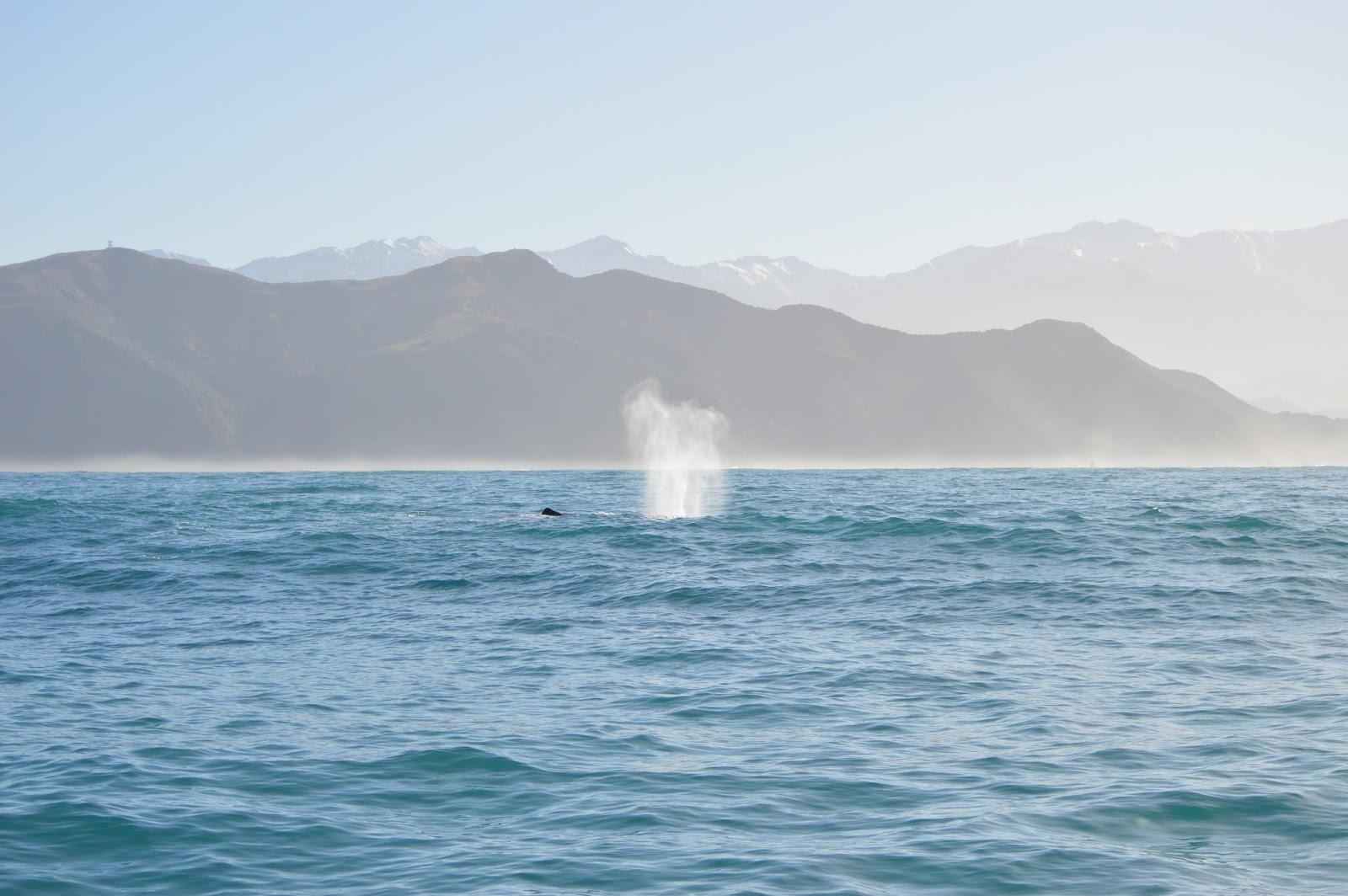
We were quite fortunate after this point to encounter another whale very quickly and we raced to it as fast as reasonably possible. The key to spotting sperm whales is to do so when they first surface. Holding your breath and diving into the deep in search of food is tiring and the whales require to stay on the surface and replenish their supply of oxygen. They will float on the surface taking great breaths to expel the built up carbon dioxide and providing tourists such as myself the opportunity to view these fantastic creatures.


It was an amazing experience for myself, to see such an animal in the wild. It seems hard to believe that this "beast" would once have been the target of whalers, hunting them for their blubber, ambergris, and spermaceti oils. These creatures are powerful and it is unsurprising that they would have posed a challenge to whalers. The "Nantucket sleigh ride" was the resulting pull of whaling boats after harpooning whales, which eventually wore the animal out. These sleigh rides were longer and at greater speeds when harpooning sperm whales compared to most other species. It is understandable in the context of their time, why whaling occurred, however it is hard to believe that such a majestic creature could be hunted to the low numbers they occur in today. I chose to shoot with my camera instead.

This whale chose to stay on the surface for probably two minutes before he took a final blow and arched his back. Slowly the caudal peduncle and the tail flukes appeared and then with a wave goodbye to the white limestone cliffs in the background, the leviathan descended back into the depths to feed.


Feeling very lucky to have had this encounter, my bliss was interrupted as we were called inside to hurry off to another sighting. We pulled up to a whale that had surfaced recently and the boat was able to get a lot closer. Every little detail was visible on this one, from the rippling pattern of the skin, to the large boxlike head that is indicative of the species. The most prominent feature from this angle however was the one nostril blowhole which blows to the left side of the whale only. More than fifteen great exhalations sending vapour and splashing water at an unusual angle rather than straight into the air.


And in the calming roll of the waves, we simply floated with this magnificent giant as we enjoyed this scenery and company of this rare creature. But before we knew it, he took a great breath and started arching his back again. We were so close this time that we could see the dropping of water off the tip of the flukes as this whale also slipped into the water and ended our encounter with these whales.


Our cetacean adventure would not end their however, as the boat traveled into the murky waters near the limestone cliffs. Here we were on the lookout for another rare creature; the Hector's dolphin, one of the smallest dolphins in the world. They are only found in New Zealand waters and I was privileged to see a small pod of these creatures appearing like phantoms out of the cloudy waters.


Feeling completely on top of the world after such a fantastic venture, it was now Mary-Ellen's turn. Although she did not get to see the Hector's dolphin, she did get to see several sperm whales as well and they were able to get pretty close to these whales. Fortunately she was able to fully enjoy the experience, unlike many others who were more than a little sea sick in the higher waves of the afternoon.


Mary-Ellen was also fortunate to get a much closer look at the shy mollymawks and managed to snap a photo for me. We shall have to go back again some day to try and see a few more of the bird species that inhabit this wonderful place.


The whole experience was one neither of us will forget, full of truly picturesque moments, some of which we managed to get with the camera. The sunny ocean, a rare creature, and the mountain backdrop, truly a day that will be with us always.


Christchurch to Kaikoura

After a happy and giggling first flight for Thomas, we arrived late at night into a dreary and cool Christchurch, which was the opposite of the wonderful and happy hosts of the hotel. After being picked up and brought to the hotel, we were happy to settle into a preheated room in anticipation of our arrival and enjoy some pizza. The next morning I picked up our rental car and we packed ourselves in for the next leg of the journey.


The drive to Kaikoura was reasonably long but it didn't take Thomas to long to fall asleep. For the first stretch of the drive we were accompanied by riverine and mountain landscapes. I of course tried to keep the stopping to a minimum but couldn't help getting out to take a few shots.


Eventually our view to the right changed from mountains to a roaring Pacific Ocean and we could see our destination in haze; the Kaikoura peninsula. A quick washroom break, a few pictures of the relentless pounding surf, and we were soon arriving in the quaint tourist town of Kaikoura.


By this point Thomas was rousing and we settled into our home away from home at a local campground. The handy motel rooms had a beautiful view of the mountains and a little stream running alongside. Although Thomas didn't really appreciate the view, he did enjoy the abundance of ducks in the stream. With a long day of travelling up the coast, we settled in and planned the remainder of the trip, including our tickets for the big whale watching venture we would enjoy the next day.


Thursday, 15 December 2016

Nana and Grampie visit again

At the end of May we got another visit from family, when Mom and Dad returned for visit with Thomas (and us). It was fantastic to have another set of hands around the house especially as I tried to finish up my thesis. It was full of fun and laughter and the experiences were new not because of where we went but that Thomas was there to experience them. In and around Auckland we visited many of our favourite places such as the zoo where Thomas still got the biggest kick out of the chickens.


Our big trip away was to Hamilton, a place Nana and Grampie had not gotten to explore their first two times to New Zealand. We took a wonderful winter stroll through the gardens enjoying the changed but yet still beautiful scenery. I think they had a good time, especially taking some family photos with Thomas.


Being such big fans of the natural world, we also headed back to the Hamilton zoo which, we had raved about after our last visit. The grandparents were not disappointed, and we also had some better sightings of the animals at this zoo. The rhinos were much closer this time around and were enjoying a brisk morning meal. The giraffes followed suit, providing Thomas with a great viewing.


With my camera in tow, I also got a chance to try and get a photograph of one of New Zealand's iconic birds, the fantail. This of course resulted in a good fifteen minutes of me chasing the fluttering bird with only a little success.


We were not the only ones out toting our young in the park. We had a unique view of a chimpanzee mother out for a stroll with her offspring, much like Thomas, peering around with his tongue sticking out.


Of course, no zoo trip would be complete without a stop to the red pandas. A great spot for Thomas to stop and have a snack while Daddy and Grampie played "focus on the running red pandas". They were still so much more active than Auckland Zoo but they did eventually stop and give us some great sights.


Overall it was a nice trip and with a big sky we all headed back to Auckland.


It was a great trip and so nice to have the extra hands. The Grandparents got some wonderful time with the little tyke, and we all shared some wonderful experiences.


Thursday, 8 December 2016

Sydney and the Shellfish Restoration Network Meeting

Towards the end of May, I got the opportunity to go to the third Shellfish Restoration Network Meeting in Sydney, Australia. This was my first time going to Sydney, and my third time to Australia. I arrived late at night, which gave me little opportunity to see much, but I was treated well the next morning. The meeting was located at Chowder Bay and I awoke early to take the bus from the CBD out to the meeting. Of course, not knowing where exactly I was going, I headed out exceedingly early. I arrived at the Sydney Institute of Marine Science and with no one around, decided to enjoy the dawn and the sites I could see. Sydney has a strong connection with the ocean, with houses and buildings directly on the waterfront, following the coastline of every inlet and peninsula in Sydney Harbour.


The Institute and surrounding Chowder Bay was a nice place and I spent a considerable amount of time watching the numerous birds foraging in the early morning light. It still feels unusual to see so many parrots and parakeets but their banter was a nice accompaniment to my early morning exploration.


The institute itself is quite a nice building and perfectly located. The water taxi comes in directly on the wharf and there was a cafe and conference room for rent, which I am sure gets well used for such functions as weddings. And what a beautiful place to have them! Although I did not get to tour through any of the science buildings, they did have an active experiment set up for public display which was a nice way to highlight the science and show visitors the importance of the research.


The day went on and as the sun rose higher, I began to worry about the timing of the event, given I had seen no signs and still no one else had arrived. I explored a small dock and the beach while I continued to wait. I didn't get to see too much but I did run across some fish and the local oysters which undoubtedly were to be the focus of much of the days meeting.


Eventually people I recognized started to show up and the meeting began. It was a very productive networking opportunity for myself and a great way to keep opportunities for collaboration and information sharing among the sparse enthusiasts and researchers working in bivalve restoration.

The next morning of this particularly short trip was the field trip to observe and discuss the efforts being conducted within the harbour to increase habitat for shoreline organisms, including oysters. It was also a great opportunity to see Sydney from a different perspective. So in the early morning light, I was up and off again to Barangaroo Reserve near the beach. One of the biggest issues with urbanisation of coastal environments is the unnatural hardening of the coastline. What was potentially boulders or mangroves has been replaced by rock or cement walls, reducing the available habitat. Like many other harbours throughout the world, Sydney has been taking action to try and counteract this loss of habitat. One way has been the restructuring of these barriers, and at the reserve, this has come in the form of a restructured rock barrier that uses a stepping pattern to increase the available space, creating crevices and pools for animals to remain sheltered from the harsh exposure during low tide. We even saw some oysters growing on the rocks, showing that the work is starting to bring these organisms back.


From there, we headed to a boat that we chartered to take us around the harbour and see some of the other work that has been trialed to increase space for the flora and fauna of Sydney's waterways.


Much of the waterfront around the CBD was either stone or cement walls. These walls were certainly not devoid of life and we were happy to see oysters growing at the water line.


One of the modifications that were employed to increase available space was the removal of stone blocks and the creation of a small barrier that trapped water when the tide receded. Another modification that we didn't get to see was the half flower pots that played a similar role on a cement wall. 


Another tool was the use of a standardized block structured cement which is being deployed in harbours around the world. This will allow researchers to monitor colonization by shoreline species and creates little islands of habitat.


We moved away from the CBD to a secluded inlet further up the estuary to have some lunch. In the less developed areas, the shoreline was still dominated by mangroves and rocky shores. With the science largely out of the way, we enjoyed a small tour to see some of the city from the water. Although I am not much of a city person, it was a beautiful skyline that day!


It is amazing to see that Sydney was so very much like Auckland in it's connection to the sea. Small and large boats were abound, from personal yachts and sailing vessels to large commercial container ships and a host of ferry's coming in and out of Circular Quay.


And to finish it all off, that most iconic buildings and symbols of not only Sydney but Australia: The Sydney Opera House. It truly has a unique architectural design we got a great look from the water. I couldn't help but feel that I was only getting a small taste of this landmark, and that I would need to actually go and see something to fully appreciate it. Perhaps a trip for another time!


Back under the bridge we went and back to the wharf where I said my goodbyes and raced back to the airport to catch my flight home.